After several years of headline-grabbing growth, Dubai property prices 2026 are entering a more mature and selective phase. The Dubai real estate market 2026 is no longer moving as one single market, with prices and demand increasingly varying between communities, property types and individual buildings.
That doesn’t necessarily mean the Dubai property market is weakening. Instead, buyers and investors are becoming more selective, paying closer attention to location, supply, rental income, service charges and long-term demand.
The Numbers Behind Dubai Property Prices 2026
Dubai recorded roughly 79,000 residential sales worth around AED 221 billion in the first half of 2026 — down from close to 92,000 transactions and AED 263 billion over the same period in 2025, a drop of about 14% in volume. Citywide, residential prices were still running around 6% higher year-on-year as of mid-2026, even as short-term, month-to-month momentum cooled. Dubai villa vs apartment prices tell much of this story: some established, supply-constrained villa communities — Palm Jumeirah, Emirates Hills, Dubai Hills Estate — are still posting solid annual gains, while certain oversupplied apartment submarkets are essentially flat or softening.
Community-by-Community: Where Prices Are Actually Moving
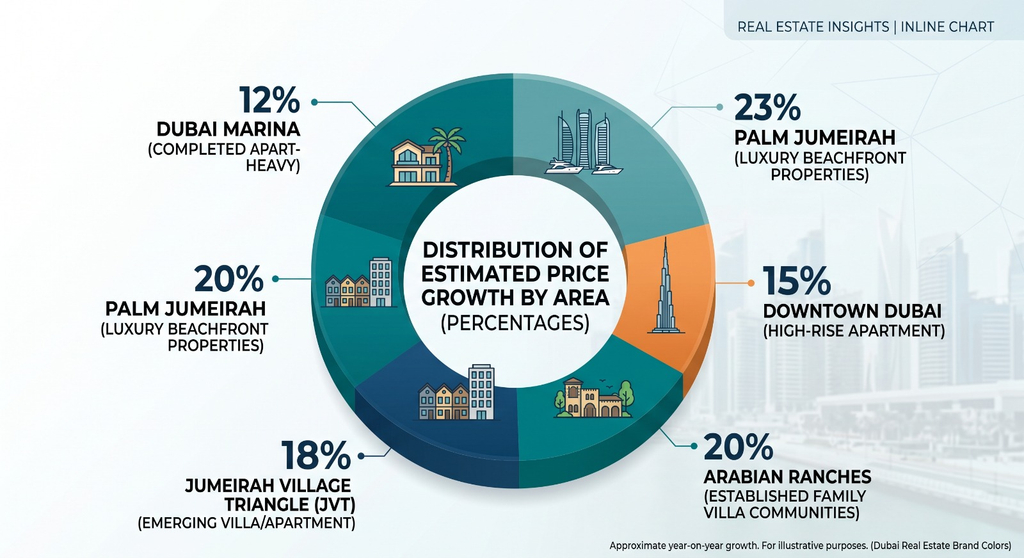
A single citywide number increasingly hides more than it reveals. Downtown Dubai, for example, has held its average sales price well above AED 2,400 per square foot through mid-2026, supported by limited land supply and steady demand for city-centre living. Meanwhile, the broader Dubai residential price index eased a few percentage points between spring and mid-2026 — not a crash, but a real divergence between prime, supply-constrained locations and newer, supply-heavy submarkets still absorbing recent handovers.
This is exactly why Dubai property prices as one headline figure has become less useful for decision-making. Buyers, sellers, and investors who zoom in to the community level are working with a far clearer picture than anyone relying on a single citywide average.
Off-Plan vs Ready: A Different Kind of Split
There’s a second divide running underneath the community-level story: off-plan versus ready property. Off-plan sales have continued to dominate transaction activity in 2026, often accounting for close to 70% of deals, while ready (secondary market) transactions have grown more modestly as a persistent gap between what sellers want and what buyers will pay has kept some resale activity in check. Off-plan launch pricing in several growth corridors still runs meaningfully below equivalent ready-market comparables — part of why new launches keep pulling in volume even as the broader market moderates.
Is the Dubai Property Market Slowing Down?
Not in the way headlines suggest. Transaction volumes have moderated compared to the exceptional pace of the previous year, but citywide prices remain well above pre-pandemic levels. A slowdown in transaction volume isn’t the same as a decline in value — it’s a shift from a market where everything rose together to one where performance depends on the specific community and property type.
Why the Dubai Real Estate Market 2026 Is Actually Healthier
For years, almost any Dubai purchase rode the same rising tide. Buyers are now doing what mature markets do: comparing service charges, checking upcoming supply pipelines in a community before committing, and weighing rental yield against price more carefully. That’s a better environment for informed buyers and investors than a market where everything moves together regardless of fundamentals.
What This Means Depending on Who You Are
- End users: Focus on communities with genuine long-term demand drivers — schools, transport links, established infrastructure — not just launch hype.
- Investors: Dubai rental yield 2026 and realistic exit timelines matter more than betting on broad citywide appreciation, especially in oversupplied segments.
- Sellers: Community-specific comps matter more than ever; a single citywide Dubai property prices average can be misleading for pricing your specific unit.
Quick Answers: Dubai Property Prices 2026
Will Dubai property prices fall in 2026? Most current forecasts point to modest, single-digit growth rather than an outright decline — but the range varies sharply by community and property type, which is the whole point of looking past the headline number.
Is now a good time to buy in Dubai? It depends far more on the specific building and community than it did two years ago. A high-yield apartment in a supply-heavy area is a different investment case entirely from a scarce villa plot in an established, land-constrained community.
Which Dubai communities are performing best in 2026? Established, land-constrained locations — central districts and mature villa communities — have generally held up better than newer submarkets absorbing large handover volumes.
The Takeaway
Dubai real estate in 2026 rewards research over momentum-chasing. The city is still growing — population continues to expand toward and past 4 million residents — but the “any property, any time” logic of a few years ago has given way to something that requires an actual strategy.